This article explores the pinnacle of horological engineering by reviewing the thinnest watches ever created, detailing the technical breakthroughs required to achieve record-breaking profiles. We analyze the top contenders from Richard Mille, Bulgari, and Piaget to understand how these manufacturers balance structural integrity with extreme slimness.
What is the thinnest watch in the world?
The Richard Mille RM UP-01 Ferrari currently holds the title of the world’s thinnest mechanical watch, measuring just 1.75mm in total thickness. It surpassed the Bulgari Octo Finissimo Ultra (1.80mm) and the Piaget Altiplano Ultimate Concept (2.0mm) by integrating the movement directly into the case and utilizing ultra-high-strength Grade 5 titanium.
The Engineering Marvel: Understanding Ultra-Thin Watches
In the world of high-end watchmaking, “thinness” is considered one of the most difficult complications to master. Unlike a tourbillon or a perpetual calendar, which add parts to a movement, the quest for the thinnest watches requires removing material and rethinking the fundamental architecture of the timepiece. For a watch to be considered “ultra-thin,” every micron counts, and the engineering challenges increase exponentially as the case height drops below 5mm.
To achieve these record-breaking dimensions, brands typically employ the following innovations:
-
Case-as-Mainplate Construction: Instead of mounting the movement inside a case, the caseback serves as the mainplate for the gears and escapement.
-
High-Tech Materials: Traditional gold or steel is often too soft at these thicknesses; therefore, manufacturers use Tungsten Carbide, Cobalt-based alloys, or Grade 5 Titanium to prevent the watch from bending.
-
Flattened Component Layout: Instead of stacking gears vertically, they are spread out horizontally across the diameter of the watch.
-
Elimination of the Crown: Traditional crowns are replaced with recessed wheels or specialized tools to wind the watch without adding vertical bulk.
Top 5 Thinnest Watches in the World: Detailed Analysis
The pursuit of the world's thinnest watch has become a high-stakes competition between three main players: Richard Mille, Bulgari, and Piaget. Below is a detailed breakdown of the leaders in this category.
1. Richard Mille RM UP-01 Ferrari (1.75mm)
The Richard Mille RM UP-01 Ferrari is a masterclass in modern materials science. Developed in collaboration with the Ferrari team, this timepiece broke the 1.8mm barrier in 2022.
-
Design Philosophy: Unlike its competitors, the RM UP-01 keeps the movement as a separate assembly within the case, rather than using the caseback as the mainplate.
-
Technical Achievement: The brand developed a patented ultra-flat escapement that removes the traditional pallet lever and safety roller, significantly reducing height.
-
Durability: Despite being only 1.75mm thick, the watch can withstand accelerations of over 5,000 Gs, making it one of the most robust ultra-thin watches ever made.
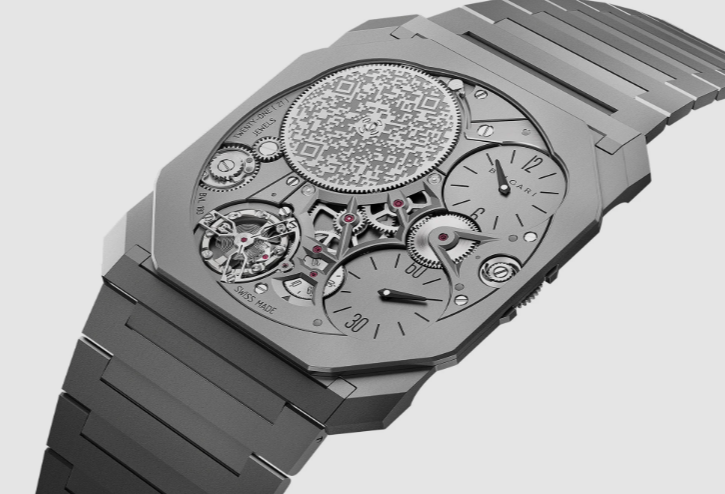
2. Bulgari Octo Finissimo Ultra (1.80mm)
Before Richard Mille took the lead, Bulgari’s Octo Finissimo Ultra was the undisputed champion. This watch represents the culmination of a decade of research into slim profiles.
-
The Movement: The Calibre BVL 180 is just 1.50mm thick. To save space, the dial, hands, and gears are all positioned on the same plane.
-
Unique Features: The watch features a prominent QR code engraved on the barrel bridge, which links to an NFT, blending traditional craftsmanship with digital luxury.
-
Material Choice: The case middle and bezel are made of sandblasted titanium, while the caseback is constructed from tungsten carbide to provide the necessary rigidity.
3. Piaget Altiplano Ultimate Concept (2.0mm)
Piaget was the original pioneer of the ultra-thin watch, dating back to their 9P and 12P calibres in the 1950s. The Altiplano Ultimate Concept (AUC) was the first watch to break the 2mm barrier.
-
Integrated Architecture: The AUC merges the case, movement, and bezel into a single unit. The sapphire crystal is only 0.2mm thick, which is roughly the thickness of two human hairs.
-
Innovation: The traditional crown is replaced by a flat, telescopic winding system that is flush with the case side.
-
Customization: Because of its unique construction, Piaget offers over 10,000 customization options for the AUC, allowing owners to choose colors and finishes for various components.
4. Jaeger-LeCoultre Master Ultra Thin Squelette (3.60mm)
Jaeger-LeCoultre (JLC) is often called the “watchmaker's watchmaker,” and their entry into the thinnest watches category focuses on skeletonization and artistic decoration.
-
Movement Calibre 849ASQ: This manual-wind movement is a marvel of open-working, where every unnecessary bit of metal is removed to showcase the internal mechanics.
-
Aesthetic Appeal: The watch is divided into several “windows” or sub-dials, often decorated with engraving or enamel, proving that ultra-thin watches can still be highly decorative.
5. Vacheron Constantin Historiques Ultra-Fine 1955 (4.13mm)
This model pays homage to the legendary Calibre 1003, which Vacheron Constantin first produced in 1955. It remains one of the most elegant dress watches in the world.
-
Heritage: The movement inside is just 1.64mm thick and is crafted from 18k gold—an incredible rarity for such a thin calibre.
-
Purity of Design: With no date window or second hand, the focus is entirely on the slim profile and the prestigious “Hallmark of Geneva” certification.
Comparison Table: The World's Thinnest Watches
To facilitate your decision-making or research, the following table compares the technical specifications of the most significant ultra-thin watches currently on the market.
| Brand & Model | Thickness | Movement Type | Case Material | Key Feature |
| Richard Mille RM UP-01 | 1.75mm | Manual | Grade 5 Titanium | 5,000 G Shock Resistance |
| Bulgari Octo Ultra | 1.80mm | Manual | Titanium / Tungsten | QR Code / NFT Integration |
| Piaget Altiplano AUC | 2.00mm | Manual | Cobalt-based Alloy | Case-Movement Integration |
| JLC Master Ultra Thin | 3.60mm | Manual | 18k Rose Gold | Skeletonized Movement |
| Vacheron Historiques | 4.13mm | Manual | 18k Pink Gold | 18k Gold Movement |
| Breguet Classique 5157 | 5.40mm | Automatic | 18k Yellow Gold | Engine-turned Dial |
| Audemars Piguet RD#2 | 6.30mm | Automatic | Platinum | World's Thinnest Perpetual |
Technical Challenges of Thin Watch Maintenance
Owning one of the thinnest watches in the world comes with specific responsibilities. Because these timepieces are engineered to the absolute limit of physical possibility, they require specialized care.
-
Service Frequency: Due to the tight tolerances, even a small amount of dried lubricant can stop a movement. Frequent servicing by the original manufacturer is mandatory.
-
Structural Sensitivity: While the Richard Mille is robust, most ultra-thin watches from Piaget or Bulgari should not be subjected to heavy impacts or tight wrist-bending, as the case can theoretically flex and interfere with the gear train.
-
Water Resistance: Most ultra-thin watches have minimal water resistance (typically 10m to 30m). They are designed for formal wear, not for swimming or sports.
-
Winding Precautions: Because the gears are so small and delicate, users must be extremely gentle when winding manual models to avoid stripping the crown wheels or snapping the mainspring.
Why Collectors Seek Ultra-Thin Watches
The appeal of the world's thinnest watch lies in its “hidden” complexity. While a large diver's watch screams for attention, an ultra-thin watch is a quiet statement of engineering dominance.
-
The “Cuff” Test: A primary reason for the popularity of slim watches is their ability to slide effortlessly under a bespoke shirt cuff. This makes them the ultimate choice for black-tie events and professional environments.
-
Wrist Comfort: Because they weigh significantly less than standard luxury watches, ultra-thin models provide a “second-skin” feel that many collectors prefer for daily wear.
-
Investment Value: Due to the extreme difficulty in manufacturing these pieces, they are produced in very low volumes. This scarcity often leads to high resale value among horological purists.
Frequently Asked Questions (FAQ)
Are thinnest watches more fragile than regular watches?
Generally, yes. While the Richard Mille RM UP-01 is built for durability, most thinnest watches use extremely thin sapphire crystals and movements that lack the shock-absorption buffers found in thicker watches. They are high-precision instruments and should be treated with care.
Which brand holds the most records for ultra-thin watches?
Historically, Piaget held the most records. However, in the last decade, Bulgari has broken eight world records in various categories, including the thinnest automatic watch, thinnest tourbillon, and thinnest perpetual calendar.
Can an automatic watch be as thin as a manual watch?
Typically, no. Automatic watches require a rotor (a heavy oscillating weight) to wind the mainspring, which adds thickness. However, brands like Bulgari and Piaget use “peripheral rotors” or “micro-rotors” that sit on the same plane as the movement to keep the profile under 6mm.
How much do the world's thinnest watches cost?
The price of ultra-thin horology is high due to the R&D involved. The Richard Mille RM UP-01 retails for approximately $1.88 million, while the Piaget Altiplano Ultimate Concept starts around $400,000. More “accessible” ultra-thin models from JLC or Vacheron Constantin typically range from $20,000 to $45,000.
Is the thinnest watch in the world waterproof?
Most ultra-thin watches offer very limited water resistance, usually rated at 10 to 30 meters. This means they are splash-resistant but should never be submerged. The gaskets required for high water resistance add significant thickness to the case, which contradicts the design goals of an ultra-thin timepiece.
Summary of the Quest for Thinness
The competition to create the world's thinnest watch has pushed the boundaries of what is possible in mechanical engineering. From the 1.75mm Richard Mille to the artistic Piaget Altiplano, these watches represent a perfect marriage of style and science. As materials science continues to evolve, the industry watches closely to see if the 1.5mm barrier can ever be safely broken. For the discerning collector, an ultra-thin watch remains the ultimate symbol of sophisticated, understated luxury.